What Changes When a Cat Book Crosses Into Spanish

We have just published a Spanish edition of one of our books, and since we did the translation ourselves rather than handing it to someone else, we spent longer than expected inside decisions that we did not anticipate having to make.

Some of them are worth writing down, because they apply to anyone translating a picture book, and because a few of them surprised us.

Names are the hardest part and they come up first

In English the cat is called Bootsie, for the white markings on his feet. That is a name doing a small amount of descriptive work while sounding like a name a person would actually use.

Spanish has an obvious equivalent in Botitas, little boots, and we took it. But the obvious equivalent is not always available, and when it is not, you have to decide what the name was for.

The other animals made this concrete. A rabbit called Ears becomes Orejitas, which keeps the diminutive warmth. A squirrel called Whiskers becomes Bigotes, which in Spanish is a slightly funnier word than Whiskers is in English, and we decided that was a gain rather than a loss. A bird called Chirp becomes Pío, which is the standard Spanish rendering of the sound a bird makes, so the name went from being descriptive to being onomatopoeic. That is a real change, and we let it stand because a small child meeting the word Pío will hear the bird immediately.

A puppy named Cinnamon becomes Canela. That one is free.

The character who does not change is Nero, because he is already a name rather than a description, and because he appears elsewhere in our catalogue.

Sentence length is not preserved

Spanish runs longer than English. Estimates vary, but a Spanish text will typically expand somewhere between fifteen and twenty five per cent against its English source.

In a novel you absorb that silently. In a picture book, where the text sits on top of an illustration inside a defined area, it is a design problem. A line that occupied one comfortable row in English can become two, which pushes the text block down into part of the image you wanted visible.

We ended up shortening sentences in Spanish that were not too long in English, purely so the type would sit where it needed to sit. That feels like a compromise until you accept that a picture book text has always been shaped by the space it occupies, in every language.

Verb tense carries more weight

English picture books lean heavily on the simple past. He looked. He waited. He smiled.

Spanish gives you a choice between the preterite and the imperfect, and the choice is not cosmetic. The preterite gives you a completed action, the imperfect gives you a continuing state or a habit. So “Botitas waited” can become an action that finished or a condition he remained in, and those are different stories about the same cat.

We went with the preterite for the moments of action and kept the imperfect for the habitual scene setting, which is the conventional handling, but it required deciding on a case by case basis what kind of waiting was happening.

Read-aloud rhythm does not survive translation on its own

This was the one we underestimated.

A repeated refrain in English is chosen partly for how it sits in the mouth. Translate it accurately and you can end up with a phrase that means exactly the right thing and is awkward to say four times in a row. Stress patterns differ, syllable counts differ, and the little click of a well built refrain is easy to lose.

The fix is unglamorous. Read every repeated line aloud, in Spanish, several times over, and change it if it does not want to be said. Meaning is easier to preserve than rhythm, so rhythm is the thing to protect deliberately.

Who the Spanish edition is actually for

We assumed the answer was Spanish speaking families. It is broader than that.

A meaningful share of the interest we see comes from households where one parent speaks Spanish and one does not, and from families who are deliberately raising bilingual children without both parents being fluent. For those readers a picture book is a low stakes way into the language, because the pictures carry the meaning if the vocabulary does not.

Teachers and dual language classrooms are a third group, and they buy differently, usually in the autumn and usually in quantity.

If you are in any of those categories, we would genuinely like to hear what you look for in a Spanish edition. It is a harder question than it looks and we are still learning the answer.

El gato que trae amigos is our Spanish edition of Bootsie Brings Everyone Home, and it joins El Milagro del Gato Negro and Tufi: El Osito Musical in our Spanish list.

How to Read a Picture Book Out Loud

Most advice about reading to children is about how often to do it. Very little of it is about how to actually do it, which is strange, because plenty of adults quietly believe they are bad at it.

They are usually not bad at it. They are usually reading a picture book as though it were a novel, which is a different instrument entirely.

Here is what we have learned, partly from writing these books and partly from watching people read them.

Read it once before you read it aloud

Picture books are short enough that this costs you four minutes, and it changes everything. You find out where the turn is, where the joke lands, and whether the last line is the punchline or the setup.

The single most common read-aloud failure is delivering a surprise you did not know was coming, in the same tone as the sentence before it.

The page turn is the punctuation

In a well made picture book, the page turn is doing structural work. It is a pause, a reveal, or a beat before a joke. The text is written around it.

So slow down at the turn. Let the hand move before the voice does. If the sentence ends with something like “One day, Botitas brought home…” then the next word belongs on the other side of the page and should arrive after the paper does, not before.

Children learn this rhythm fast, and they will start anticipating the turn themselves, which is the beginning of reading.

Repetition is an invitation, not filler

A lot of picture books repeat a line, sometimes four or five times. Adults sometimes find this tedious and speed up.

Do the opposite. The repeated line is the part the child is going to take over. Say it exactly the same way each time, with the same rhythm and the same emphasis, and by the third occurrence you will notice them mouthing it. By the fourth, let your voice drop out slightly and see whether they fill the gap.

That handover is the entire point of the device. Rushing it throws away the best thing in the book.

Fewer voices than you think

You do not need a distinct character voice for everyone. Two is plenty for most picture books: your reading voice, and one other. Pitch and pace do more work than accent, and a voice you cannot reproduce consistently is worse than no voice at all, because children notice and will tell you.

If a character laughs in the text, actually laugh. That one is worth more than any accent.

Let them stop you

The reflex is to keep going to the end. Resist it. A child interrupting to point at something in the illustration is not derailing the reading, they are doing the reading. Picture books carry a great deal of their content in pictures, and much of it is not in the words at all.

In our own books there is usually something happening in the background that the text never mentions. A previous visitor asleep in an armchair. Somebody watching from a window. Those are put there deliberately, for exactly this moment.

The re-read is not a failure of imagination

You will be asked for the same book again. And again. This is not a sign that you should introduce more variety.

Repetition is how young children consolidate language. The fifteenth reading is doing different work from the first: by then the plot is settled and they are free to attend to the sentences, the rhythm, the individual words. A book that survives forty readings is not a book that ran out of ideas. It is a book that was built to be read forty times.

Which is worth knowing if you are ever choosing between a book that dazzles once and a book that holds.

A note for grandparents

A disproportionate number of the people who write to us are grandparents, usually reading to a child during a visit rather than every night.

That changes the calculation slightly. When reading is an occasional event rather than a daily routine, the book carries more weight, and familiarity matters more, not less. Reading the same book every visit is not a lack of effort. It becomes the thing the child associates with you, which after a while is the whole point.

One practical suggestion: keep your copy at your house. A book that lives at Grandma’s and is only read at Grandma’s becomes a small ceremony in a way that a book carried back and forth never quite does.

Tell us: what is the book your household has read the most times, and are you still willing to read it?

Why Your Cat Brings You Things

If you have ever opened a door at six in the morning to find a cat sitting expectantly beside something small and no longer alive, you have participated in one of the more misunderstood rituals of living with a cat.

The usual explanation you will hear is that your cat is teaching you to hunt. It is a satisfying story. It is also not really what the evidence suggests.

The kitten theory

The explanation researchers tend to favour is less flattering and much more interesting.

Mother cats bring killed and injured prey back to their kittens, first as food and later as practice. It is a normal part of raising a litter. The behaviour is deeply built in, and it does not switch off just because a cat is living in a house with people instead of in a colony with kittens.

Emmanuelle Baudry, an urban ecologist at Paris-Saclay University, has put it about as plainly as it can be put: domestic cats may simply regard their owners as, in her phrase, not so efficient kittens.

Read that again, because it reframes the whole thing. Your cat is not congratulating you. Your cat has assessed your hunting ability, reached a conclusion, and is quietly compensating.

Dr. Stephanie Liff, a veterinarian in New York, takes the kinder reading of the same behaviour: that it is somewhat of a compliment, because it means the cat counts you as family and is comfortable enough to bring food into the shared space.

Both can be true at once. You have been categorised as household, and as household, you are being fed.

The other explanation

There is a second and less romantic theory, which is that your house is simply the safest place your cat knows.

A cat eating outdoors is a cat that can be interrupted, robbed, or become prey itself. A cat that carries something home to the hallway rug is choosing a location where nothing is going to challenge it. Under that reading the delivery is not for you at all. You just happen to live in the safe room.

Which cats do it most

Baudry’s 2023 work in Ecology and Evolution found that the behaviour is not evenly distributed, and the pattern is not the one most people would guess.

Bolder, more dominant, more active cats bring more prey home. Shy and notably friendly cats bring less. Outdoor access and the surrounding environment matter a great deal, which is unsurprising, but the personality effect holds.

So the cat delivering things to your doorstep is usually the confident one. The nervous cat that hides when the doorbell rings is generally not running a delivery service.

What to do about it

Three things are worth knowing.

Do not scold. The behaviour is instinctive rather than deliberate, and punishment tends to produce a cat that hides the prey rather than one that stops hunting.

A bell helps less than you would hope. Collar bells reduce catch rates somewhat but not reliably, and a practised hunter learns to move around them. Keeping a cat indoors at dawn and dusk does considerably more.

Consider what else you are being brought. Plenty of indoor cats run the same behaviour with objects: hair ties, socks, a particular toy, a leaf carried in on somebody’s shoe, deposited by the bed overnight. It is the same instinct, redirected. If your cat has never hunted anything in its life and still brings you a bottle cap at two in the morning, this is what that is.

The version we wrote

This behaviour is, if you look at it from the right angle, a story about a cat who keeps bringing things home to somebody it has decided to look after.

That is more or less the premise of our new book, El gato que trae amigos. Botitas is a black and white cat who lives with an older man named Don Manuel on a quiet street, and Botitas keeps arriving home with new friends. Not prey. Friends. A rabbit. A squirrel. A bird. A puppy. And each time, Don Manuel looks at the newcomer and cheerfully announces that he already knows them, which is not the reaction Botitas is hoping for.

We took the real instinct and asked what would happen if a cat applied it to company instead of food, and if the person receiving the deliveries turned out to have a much wider social circle than the cat expected.

It is out now, in Spanish. We will have more to say about the translation itself in a couple of weeks.

Over to you: what is the strangest thing your cat has ever brought you? The bar in this household is currently held by a single unbroken eggshell.

Black Cats, Bad Luck, and the October Problem

Every year around this time, black cats start showing up on porches, in shop windows, and on the front of greeting cards with their backs arched. And every year, a particular claim starts circulating with them: that black cats are the last to be adopted, and that shelters stop adopting them out in October to protect them.

Both halves of that are worth looking at, because one is more complicated than people think and the other is mostly not true.

Where the superstition actually comes from

The association between black cats and misfortune is not ancient and it is not universal. It is regional, and it is relatively recent in the long history of people living with cats.

In much of the medieval and early modern European imagination, the black cat became attached to witchcraft, night, and the idea of a creature that moves unseen. The colour was doing the work rather than the animal. A cat that disappears into shadow at dusk is a useful image for anyone telling a story about things that happen when you are not looking.

Elsewhere the sign flips entirely. In Japan, a black cat crossing your path has long been read as good fortune, particularly for women seeking a match. In parts of Britain, a black cat arriving at the house is lucky, and sailors’ families kept them for safe returns. In Scotland, a strange black cat on the porch was a sign of coming prosperity.

So the superstition is not a fact about black cats. It is a fact about which story a particular place happened to tell.

What the shelter research shows

Here is where it gets more interesting than the usual version of this article.

The belief that black cats fare worse in shelters is not baseless. Robert Carini and colleagues at the University of Louisville looked at 7,983 cats at an urban Kentucky shelter and did find what researchers call black cat bias: lower adoption rates and higher euthanasia rates for black cats compared with lighter coated ones. The pattern ran roughly white, then brown and grey, then black.

But Carini was careful about the size of the effect. He described the patterns as weak in strength, while adding the obvious point that from the cat’s side of it the outcome matters enormously regardless of effect size.

Other analysts have pushed back harder. Shelter Animals Count, which works with animal level data across a large number of organisations, has argued that black cats are not in fact struggling to find homes and that their adoption rates are strong.

The honest summary is that the effect is real in some datasets, modest where it appears, and contested overall. It is not the crisis it is often described as, and it is not nothing.

The October finding

The part of the Louisville research that surprised us most concerns this exact month.

Within that dataset there was a subset of roughly 1,200 entirely black cats. If the popular story were true, that October brings a rush of interest in black cats, you would expect their adoption numbers to rise in the autumn. They did not. The study found no improved adoption rate for black cats in October.

That is worth sitting with. The month most associated with black cats in the public imagination did nothing measurable for the black cats actually waiting in kennels.

And the adoption ban

The other claim, that shelters routinely suspend black cat adoptions in October to protect them from people with bad intentions, turns out to be thin. Some organisations have done it, usually out of caution rather than in response to documented incidents. Many more have publicly stopped, on the grounds that it keeps cats in kennels longer during one of the busiest adoption months of the year, and that the risk it guards against has never been well evidenced.

If a shelter near you does pause black cat adoptions in October, that is their call and they will have their reasons. It is just not the widespread practice it is often presented as.

Why any of this matters to a children’s book publisher

Because the stories we tell about animals attach to them and stay attached, sometimes for centuries, and they change what happens to real animals.

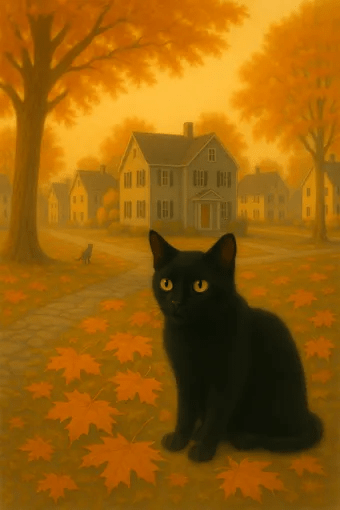
A black cat in a picture book is almost never neutral. It is either a Halloween prop or it is being gently rehabilitated. We have spent time on this ourselves, and our own black cat characters are ordinary domestic animals with opinions and habits, not omens. Nero, who turns up in more than one of our books, is a black cat whose defining trait is that he lies down suddenly and without warning. That is the whole of his mystery.

If you are choosing books this autumn, it is worth noticing which ones let a black cat simply be a cat.

A small ask: if you have a black cat, this is a good month to post a photograph of them doing something completely unremarkable. The internet has enough arched backs.

Everyday Moments: What Our Cats Notice That We Don’t

Cats spend an enormous amount of time watching things we’ve stopped noticing. The mail carrier’s footsteps two houses down. A car that doesn’t belong. The particular creak of a floorboard before anyone touches the door. Long before any of that becomes ‘news’ to us, it’s already old news to the cat on the windowsill.

Researchers who study cat behavior point to their extraordinarily sensitive hearing and their instinct to track movement and routine as a survival trait — even indoor cats who will never face a real predator keep the habit. These days it’s less about danger and more about pattern-recognition: cats notice when something in the daily rhythm of a house is even slightly different.

It’s a small thing, but it’s part of what makes sharing a home with a cat interesting. They’re quiet company, but they’re rarely just resting — they’re paying attention to a version of your house that you don’t fully see.

If you’d like a slightly more dramatic version of a watchful cat, our character Nero in The Black Cat Who Spoke for Love keeps an eye on his whole neighborhood. You can meet him in the first chapter, free to read.

Behind the Story: How a Hospital Stay Turned Into a Children’s Book

Every book has an origin story, and ours are usually less tidy than people expect. A while back, I wrote a longer piece on Medium about how a friend’s hospital stay — and my own cat’s odd habit of showing up right when she was needed — ended up pushing me to write my very first children’s book.

I won’t repeat the whole story here, but the short version is that inspiration for a children’s book rarely arrives in a straight line. It usually comes from something ordinary — a worried afternoon, a cat curled up in exactly the right spot — that only looks like the beginning of a book after the fact.

If you’d like the full account, you can read it on Medium. And if you enjoy this kind of behind-the-scenes writing, we’ll share more of these essays here from time to time.

A Few Cat Blogs & Resources We Love

Part of why we started this blog is that we enjoy the wider world of cat writing online just as much as we enjoy writing our own stories. So every so often, we’ll use this space to point you toward other cat-related corners of the internet that we think are worth your time.

The Purrington Post is one of our favorites: a long-running blog covering cat behavior, health, and heartwarming rescue stories, written with a genuine love for the animals rather than just clicks. If you’re looking for practical advice mixed with good storytelling, it’s a great place to start.

If you’re interested in the bigger picture of cat welfare, Community Cats Central focuses on community cat programs, trap-neuter-return efforts, and resources for people trying to help outdoor cats in their neighborhoods. It’s a good reminder of how much work happens behind the scenes for cats who don’t have a home yet.

We’ll keep adding to this list as we come across more good reading. If you have a favorite cat blog or resource yourself, feel free to mention it in the comments.

The Cats Who Stole the Book: Nine Classics Where the Cat Is the Star

Dogs get the loyalty stories. Horses get the noble ones. Cats get something stranger and, we’d argue, better — they get to be the narrator who knows more than everyone else in the room and refuses to explain how.

That’s the trick of a good cat book. A cat is a built-in outsider. It lives in the house but isn’t quite of it, watches the humans do their absurd human things, and comments — sometimes out loud, sometimes just with the slow blink that says I have seen you at your worst and I have decided to stay anyway. Writers have been borrowing that vantage point for centuries.

Here are nine classics where the cat isn’t the pet in the background. The cat is the whole point.


1. Puss in Boots — Charles Perrault (1697)

The ur-text. A miller dies and leaves his youngest son nothing but a cat, which sounds like the setup for a very short and very sad story. Instead the cat asks for a pair of boots and a bag, and proceeds to run a long con so elaborate it makes his penniless owner into a marquis with a castle and a princess.

Perrault didn’t invent him — versions appear in Straparola around 1550 and Basile in 1634 — but Perrault’s is the one that stuck, published in Histoires ou contes du temps passé. Two things people misremember: the cat is never actually named, and “the Marquis de Carabas” is the human, not the cat. The cat doesn’t need a title. He’s doing fine.

2. The Black Cat — Edgar Allan Poe (1843)

The other end of the emotional spectrum entirely. Published in the Saturday Evening Post, Poe’s story follows a narrator whose drinking curdles into cruelty — he blinds and then hangs his cat, Pluto, and the guilt goes looking for a way out. It finds one in a second, near-identical cat with a white mark on its chest.

It’s forty-odd pages of dread, and the cat is both victim and instrument of justice. Not a bedtime read. But it’s the story that proved a cat could carry the entire moral weight of a piece of fiction, and horror writers have been in its debt ever since.

3. Alice’s Adventures in Wonderland — Lewis Carroll (1865)

The Cheshire Cat is barely in it. He appears, dispenses some of the most quoted nonsense in English literature — “we’re all mad here” — and dissolves, leaving the grin behind. Alice, reasonably: “I’ve often seen a cat without a grin, but a grin without a cat! It’s the most curious thing I ever saw in my life.”

He isn’t the protagonist, so consider this an honorable mention with an asterisk. But no list of literary cats is honest without him, and he did something no other character in the book manages: he tells Alice the truth, and then he leaves.

4. I Am a Cat — Natsume Sōseki (1905–06)

If you read one book on this list, make it this one. Sōseki’s debut was serialized across ten installments in the magazine Hototogisu, and it’s narrated entirely by a stray who has wandered into the home of a dyspeptic schoolteacher and stayed to judge him.

“I am a cat. I have as yet no name.” That’s the opening. What follows is Meiji-era Japan seen sideways — the pretensions of the intellectual class, the collision of Western manners with Japanese ones, the sheer daily ridiculousness of being a person — all filtered through an animal with no stake in any of it. It’s very funny. It’s also, in the last pages, quietly devastating.

5. The Tale of Tom Kitten — Beatrix Potter (1907)

Mrs. Tabitha Twitchit scrubs her three kittens, puts them in uncomfortable clothes, and instructs them to behave for company. This lasts approximately four minutes. Tom loses his buttons, the Puddle-Ducks make off with the clothes entirely, and the tea party proceeds without them.

Potter understood something most children’s writers miss: the joke isn’t that the kittens misbehave, it’s that anyone believed they wouldn’t. Potter drew several cats — Miss Moppet, Samuel Whiskers’ unfortunate co-star (also Tom), the long-lost Kitty-in-Boots that sat unpublished until 2016 — but Tom is the one who gets to be the lead.

6. Millions of Cats — Wanda Gág (1928)

An old man goes out to find one cat for his lonely wife and comes home followed by “hundreds of cats, thousands of cats, millions and billions and trillions of cats.” Then it gets dark — the cats argue over which is prettiest and eat each other — and then it gets tender, because the one survivor is the scrawny kitten who never thought she was pretty at all.

It won a Newbery Honor in 1929 (the Caldecott didn’t exist yet), and it’s widely described as the oldest American picture book still in print. Ninety-odd years on, the rhythm of that refrain still works out loud. Read it to a toddler and watch them join in by the third page.

7. Old Possum’s Book of Practical Cats — T. S. Eliot (1939)

Yes, that T. S. Eliot. The man who wrote The Waste Land also wrote a poem about a cat named Macavity who is never at the crime scene, and one about Skimbleshanks, who runs a train.

The poems started as letters to his godchildren, signed with the “Old Possum” nickname Ezra Pound gave him, and Faber published them in October 1939 in a first run of about 3,000 copies. Forty years later Andrew Lloyd Webber turned them into Cats, which is either the best or worst thing that ever happened to this book depending on who you ask. Read the poems anyway. They’re better than their reputation.

8. The Cat in the Hat — Dr. Seuss (1957)

Born out of an argument. John Hersey wrote an essay in Life in 1954 attacking the “insipid” Dick-and-Jane primers, and Houghton Mifflin’s William Spaulding handed Geisel a beginner vocabulary list and told him to write a story first-graders couldn’t put down.

Geisel used 236 distinct words and produced pure anarchy in a striped hat — a cat who arrives on a rainy afternoon, wrecks the house, and cleans it up one second before Mother gets home. The genius is the fish, honestly. The fish is every anxious adult who has ever tried to stop a cat from doing something.

(A myth worth killing: the famous fifty-word bet with Bennett Cerf produced Green Eggs and Ham, not this one.)

9. The Cat Who Could Read Backwards — Lilian Jackson Braun (1966)

The book that invented an entire shelf at the library. Reporter Jim Qwilleran meets a Siamese named Koko who solves crimes by knocking things off surfaces, which is the most plausible detective methodology ever put to paper.

Braun wrote three, stopped for eighteen years, then came back in 1986 and wrote twenty-six more. Yum Yum doesn’t show up until book two. The whole cozy-mystery genre owes this one a debt.


And a few modern ones, while we’re here

The Amazing Maurice and His Educated Rodents (Terry Pratchett, 2001) won the Carnegie Medal and features a talking cat running a Pied Piper scam. Varjak Paw (S. F. Said, 2003) is a Mesopotamian Blue kitten learning cat martial arts, illustrated by Dave McKean. Into the Wild (Erin Hunter, 2003) launched the Warriors saga and has kept a generation of nine-year-olds reading. And Dewey (Vicki Myron, 2008) is the true story of a kitten found in a library book drop in Spencer, Iowa, who became the town’s heart for nineteen years.


What we’re adding to the shelf

We’ll be honest about our bias here: nearly everything One Fifteen Press publishes is narrated, one way or another, by a very opinionated cat. It seemed only fair to say where our own books sit in this tradition.

The Flopping Cat (ages 2–5) is our Millions of Cats impulse — a picture book built on a repeat-along refrain, where Nero the black cat gets breakfast, affection, playtime and the good sunny spot by deploying his one move: flopping. If you live with a cat, you already know this book.

The Black Cat Who Spoke for Love (ages 8–12) is closer to Varjak Paw territory — a young cat named Nero discovers his elderly neighbor John is being pressured out of his home, and rounds up the neighborhood cats to show John how much he’s worth to the people around him. It’s about community, quiet courage, and the kind of friendship that skips a few generations. Also available in Spanish as El Milagro del Gato Negro.

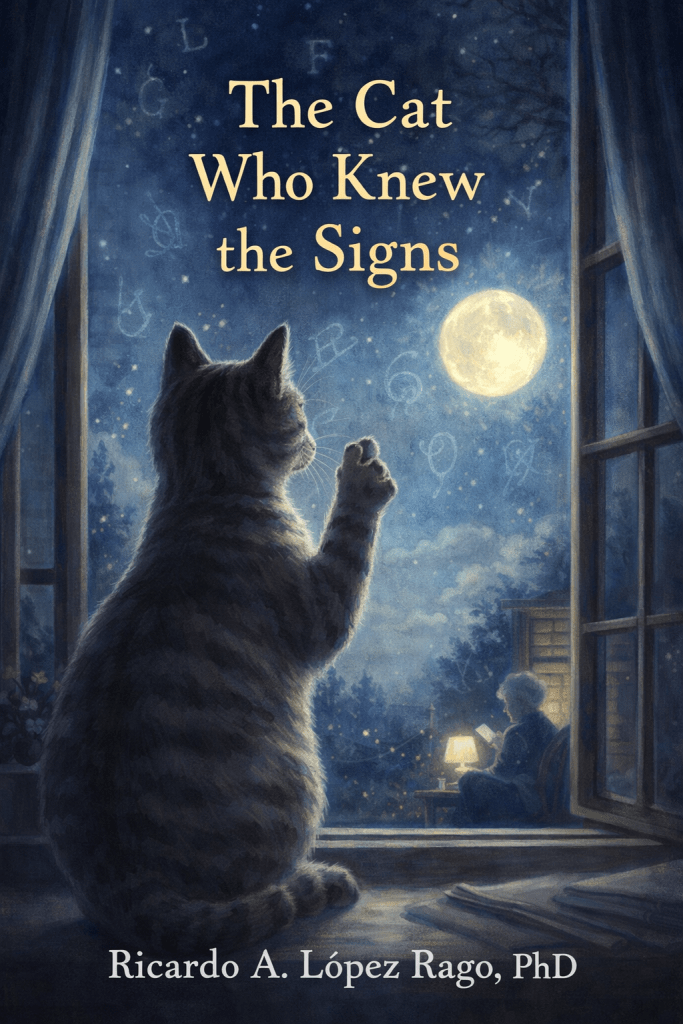
The Cat Who Knew the Signs (ages 8+) follows Libby, an ASL teacher wondering whether her work made a difference, until her former students start coming back — and her watchful cat turns out to have been paying closer attention than anyone.

Mojo and the Dream That Changed Everything (ages 8+) belongs to the Cheshire tradition of cats who show up to tell you the truth. Erica Vinoverde has lost her sense of smell; Mojo, a black cat with green eyes, walks her through a dream and out the other side of the idea that being different means being incomplete.

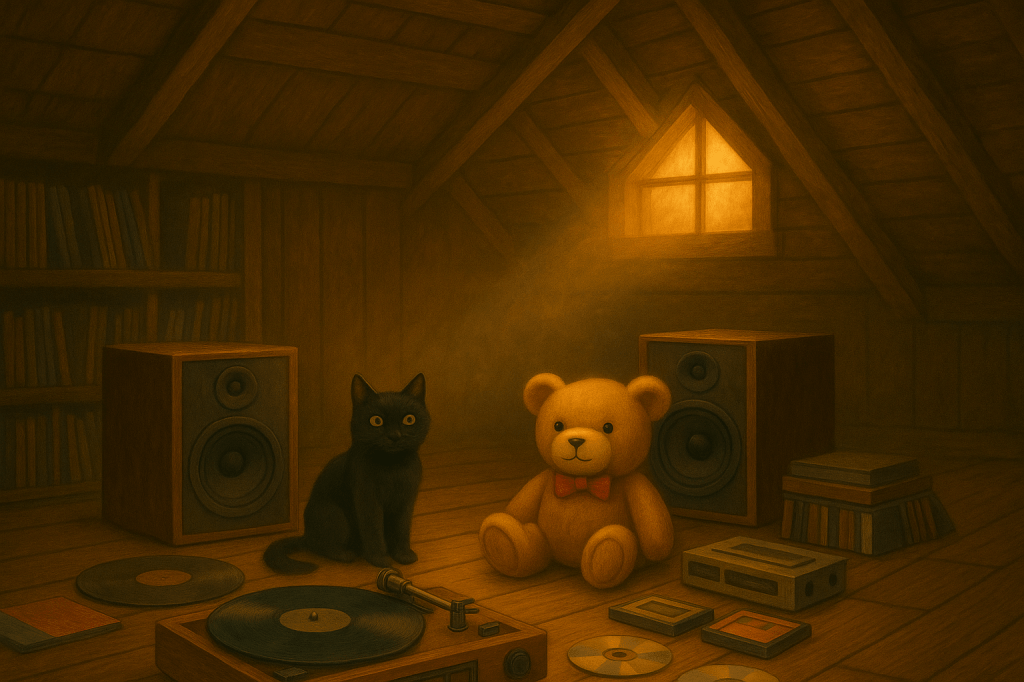
The Secret of the Music Bear in the Attic (ages 8+) is the one where Nero doesn’t take top billing — and proves the point anyway. Two brothers would never have found the talking teddy bear at all if a curious cat hadn’t led them up to the attic in the first place. What they find there is a bear who remembers every song, and a set of magical rooms built from musical memory: vinyl, cassettes, CDs, streaming, each one holding a story about how music used to live in our hands. Nero doesn’t sing, and he doesn’t explain. He just knows where the door is, which is a very old job for a cat — think of the Cheshire Cat pointing Alice down the path, or Puss simply deciding his master’s life was going to change today. Also available in Spanish as Tufi: El Osito Musical.

And for grown-ups, The Black Cat in the Back Row is our Sōseki book, if we’re allowed to be that presumptuous. It’s an illustrated novella about Antonio Vinoverde, an economics professor thirty years into a career he’s no longer sure mattered. A black cat appears in the back of his classroom, and what follows is gentle magical realism about attention, doubt, and the people who carry us farther than we’ll ever see.

That’s the thread running through all of it, and through every book on this list: the cat sees what we’ve stopped noticing, or knows the way to a room we’d never have opened. Sometimes it’s a joke. Sometimes it’s the whole story. And sometimes the cat isn’t the star at all — he just gets everyone to the attic and lets the bear do the talking.


Have a favorite cat book we left out? Tell us — we’re always taking recommendations, and so is Nero.

Why Cats Love the Quiet, Hidden Corners of a House

If you share your home with a cat, you already know the drill: the moment a box, closet, or attic hatch is left open, your cat is there first. It’s not random. Cats are drawn to small, enclosed, quiet spaces for reasons that go back long before they ever curled up on a couch.

In the wild, tight spaces offer two things a cat’s instincts crave: safety from anything bigger, and a perfect vantage point for watching without being watched. A snug hiding spot also helps a cat settle down when stressed — many behaviorists note that an overwhelmed cat will look for the smallest, darkest corner available until things feel steady again.

Attics are an especially good example. They’re dim, elevated, full of interesting boxes, and usually undisturbed for long stretches — basically a five-star hotel by feline standards. If your cat has ever gone missing for an afternoon only to turn up in the attic looking extremely pleased with themselves, now you know why.

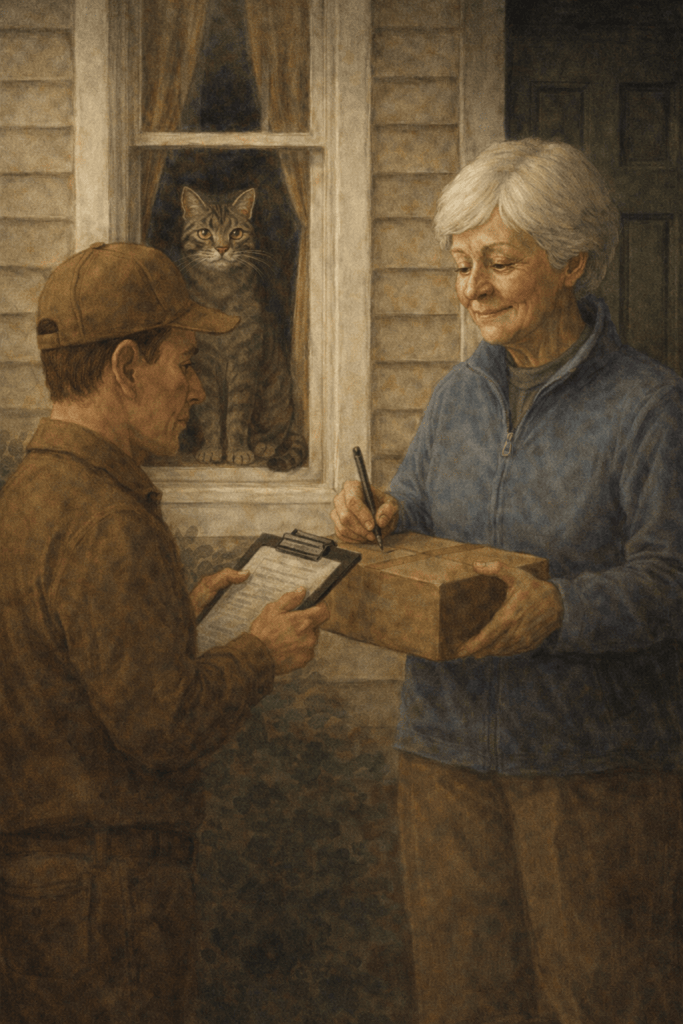
That same quiet, watchful nature shows up in Tufi, the observant black cat at the center of our book The Cat Who Knew the Signs. If you’d like to meet him, you can read the first chapter for free right here.

The Cat Who Knew the Signs

A Story of Language, Belonging & Quiet Courage: A children’s book that celebrates ASL teachers, Deaf culture, and the connections that last a lifetime.

The Cat Who Knew the Signs, © 2026 Ricardo A. López Rago. One Fifteen Press.

In this heartwarming story, Libby — a dedicated ASL teacher — wonders if her years of teaching left a mark on the world.

When her former students return, bearing the language she gave them into their lives and families, she begins to believe her work mattered after all.

And when her ever-watchful cat begins to understand more than anyone expected, Libby discovers that communication and belonging can transcend any voice.

This is a story about:
• Language and connection
• The beauty of signing
• Teachers who shape lives
• The power of empathy and patience. Recommended for ages 8 and up.

Editorial Review
“Heartwarming and quietly magical, The Cat Who Knew the Signs is a beautifully illustrated tribute to the power of language, memory, and love, told through the eyes of a silent observer who sees what others miss and helps bring a community back together.”
— NewInBooks

Find it on Amazon