Dogs get the loyalty stories. Horses get the noble ones. Cats get something stranger and, we’d argue, better — they get to be the narrator who knows more than everyone else in the room and refuses to explain how.
That’s the trick of a good cat book. A cat is a built-in outsider. It lives in the house but isn’t quite of it, watches the humans do their absurd human things, and comments — sometimes out loud, sometimes just with the slow blink that says I have seen you at your worst and I have decided to stay anyway. Writers have been borrowing that vantage point for centuries.
Here are nine classics where the cat isn’t the pet in the background. The cat is the whole point.
1. Puss in Boots — Charles Perrault (1697)
The ur-text. A miller dies and leaves his youngest son nothing but a cat, which sounds like the setup for a very short and very sad story. Instead the cat asks for a pair of boots and a bag, and proceeds to run a long con so elaborate it makes his penniless owner into a marquis with a castle and a princess.
Perrault didn’t invent him — versions appear in Straparola around 1550 and Basile in 1634 — but Perrault’s is the one that stuck, published in Histoires ou contes du temps passé. Two things people misremember: the cat is never actually named, and “the Marquis de Carabas” is the human, not the cat. The cat doesn’t need a title. He’s doing fine.
2. The Black Cat — Edgar Allan Poe (1843)
The other end of the emotional spectrum entirely. Published in the Saturday Evening Post, Poe’s story follows a narrator whose drinking curdles into cruelty — he blinds and then hangs his cat, Pluto, and the guilt goes looking for a way out. It finds one in a second, near-identical cat with a white mark on its chest.
It’s forty-odd pages of dread, and the cat is both victim and instrument of justice. Not a bedtime read. But it’s the story that proved a cat could carry the entire moral weight of a piece of fiction, and horror writers have been in its debt ever since.
3. Alice’s Adventures in Wonderland — Lewis Carroll (1865)
The Cheshire Cat is barely in it. He appears, dispenses some of the most quoted nonsense in English literature — “we’re all mad here” — and dissolves, leaving the grin behind. Alice, reasonably: “I’ve often seen a cat without a grin, but a grin without a cat! It’s the most curious thing I ever saw in my life.”
He isn’t the protagonist, so consider this an honorable mention with an asterisk. But no list of literary cats is honest without him, and he did something no other character in the book manages: he tells Alice the truth, and then he leaves.
4. I Am a Cat — Natsume Sōseki (1905–06)
If you read one book on this list, make it this one. Sōseki’s debut was serialized across ten installments in the magazine Hototogisu, and it’s narrated entirely by a stray who has wandered into the home of a dyspeptic schoolteacher and stayed to judge him.
“I am a cat. I have as yet no name.” That’s the opening. What follows is Meiji-era Japan seen sideways — the pretensions of the intellectual class, the collision of Western manners with Japanese ones, the sheer daily ridiculousness of being a person — all filtered through an animal with no stake in any of it. It’s very funny. It’s also, in the last pages, quietly devastating.
5. The Tale of Tom Kitten — Beatrix Potter (1907)
Mrs. Tabitha Twitchit scrubs her three kittens, puts them in uncomfortable clothes, and instructs them to behave for company. This lasts approximately four minutes. Tom loses his buttons, the Puddle-Ducks make off with the clothes entirely, and the tea party proceeds without them.
Potter understood something most children’s writers miss: the joke isn’t that the kittens misbehave, it’s that anyone believed they wouldn’t. Potter drew several cats — Miss Moppet, Samuel Whiskers’ unfortunate co-star (also Tom), the long-lost Kitty-in-Boots that sat unpublished until 2016 — but Tom is the one who gets to be the lead.
6. Millions of Cats — Wanda Gág (1928)
An old man goes out to find one cat for his lonely wife and comes home followed by “hundreds of cats, thousands of cats, millions and billions and trillions of cats.” Then it gets dark — the cats argue over which is prettiest and eat each other — and then it gets tender, because the one survivor is the scrawny kitten who never thought she was pretty at all.
It won a Newbery Honor in 1929 (the Caldecott didn’t exist yet), and it’s widely described as the oldest American picture book still in print. Ninety-odd years on, the rhythm of that refrain still works out loud. Read it to a toddler and watch them join in by the third page.
7. Old Possum’s Book of Practical Cats — T. S. Eliot (1939)
Yes, that T. S. Eliot. The man who wrote The Waste Land also wrote a poem about a cat named Macavity who is never at the crime scene, and one about Skimbleshanks, who runs a train.
The poems started as letters to his godchildren, signed with the “Old Possum” nickname Ezra Pound gave him, and Faber published them in October 1939 in a first run of about 3,000 copies. Forty years later Andrew Lloyd Webber turned them into Cats, which is either the best or worst thing that ever happened to this book depending on who you ask. Read the poems anyway. They’re better than their reputation.
8. The Cat in the Hat — Dr. Seuss (1957)
Born out of an argument. John Hersey wrote an essay in Life in 1954 attacking the “insipid” Dick-and-Jane primers, and Houghton Mifflin’s William Spaulding handed Geisel a beginner vocabulary list and told him to write a story first-graders couldn’t put down.
Geisel used 236 distinct words and produced pure anarchy in a striped hat — a cat who arrives on a rainy afternoon, wrecks the house, and cleans it up one second before Mother gets home. The genius is the fish, honestly. The fish is every anxious adult who has ever tried to stop a cat from doing something.
(A myth worth killing: the famous fifty-word bet with Bennett Cerf produced Green Eggs and Ham, not this one.)
9. The Cat Who Could Read Backwards — Lilian Jackson Braun (1966)
The book that invented an entire shelf at the library. Reporter Jim Qwilleran meets a Siamese named Koko who solves crimes by knocking things off surfaces, which is the most plausible detective methodology ever put to paper.
Braun wrote three, stopped for eighteen years, then came back in 1986 and wrote twenty-six more. Yum Yum doesn’t show up until book two. The whole cozy-mystery genre owes this one a debt.
And a few modern ones, while we’re here
The Amazing Maurice and His Educated Rodents (Terry Pratchett, 2001) won the Carnegie Medal and features a talking cat running a Pied Piper scam. Varjak Paw (S. F. Said, 2003) is a Mesopotamian Blue kitten learning cat martial arts, illustrated by Dave McKean. Into the Wild (Erin Hunter, 2003) launched the Warriors saga and has kept a generation of nine-year-olds reading. And Dewey (Vicki Myron, 2008) is the true story of a kitten found in a library book drop in Spencer, Iowa, who became the town’s heart for nineteen years.
What we’re adding to the shelf
We’ll be honest about our bias here: nearly everything One Fifteen Press publishes is narrated, one way or another, by a very opinionated cat. It seemed only fair to say where our own books sit in this tradition.
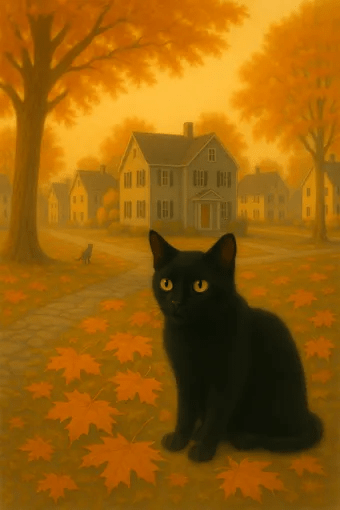
The Flopping Cat (ages 2–5) is our Millions of Cats impulse — a picture book built on a repeat-along refrain, where Nero the black cat gets breakfast, affection, playtime and the good sunny spot by deploying his one move: flopping. If you live with a cat, you already know this book.
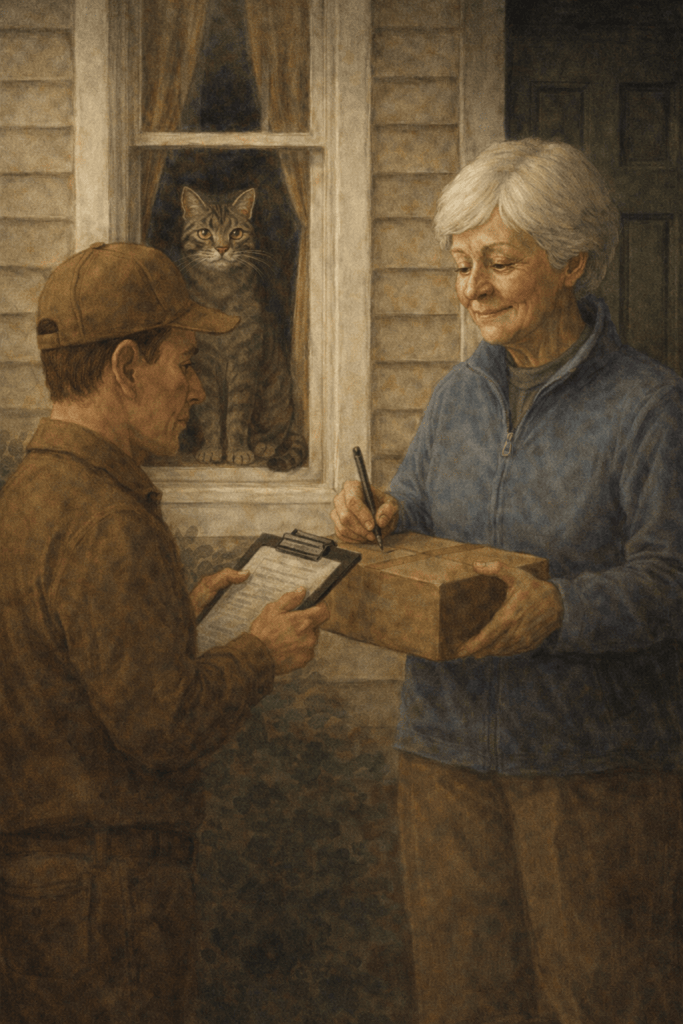
The Black Cat Who Spoke for Love (ages 8–12) is closer to Varjak Paw territory — a young cat named Nero discovers his elderly neighbor John is being pressured out of his home, and rounds up the neighborhood cats to show John how much he’s worth to the people around him. It’s about community, quiet courage, and the kind of friendship that skips a few generations. Also available in Spanish as El Milagro del Gato Negro.
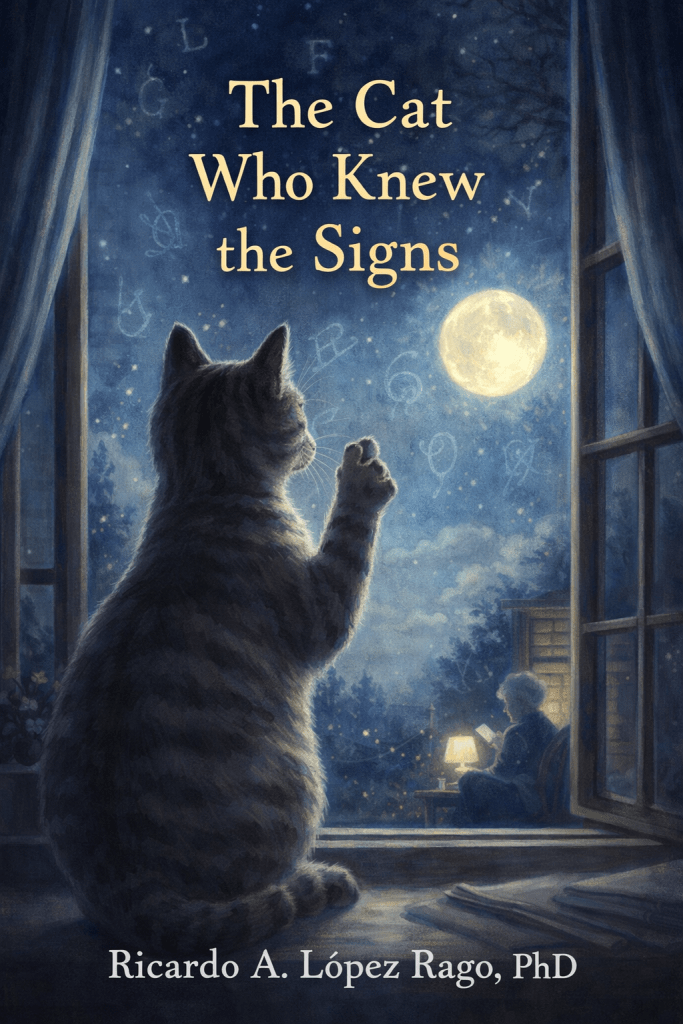
The Cat Who Knew the Signs (ages 8+) follows Libby, an ASL teacher wondering whether her work made a difference, until her former students start coming back — and her watchful cat turns out to have been paying closer attention than anyone.
Mojo and the Dream That Changed Everything (ages 8+) belongs to the Cheshire tradition of cats who show up to tell you the truth. Erica Vinoverde has lost her sense of smell; Mojo, a black cat with green eyes, walks her through a dream and out the other side of the idea that being different means being incomplete.
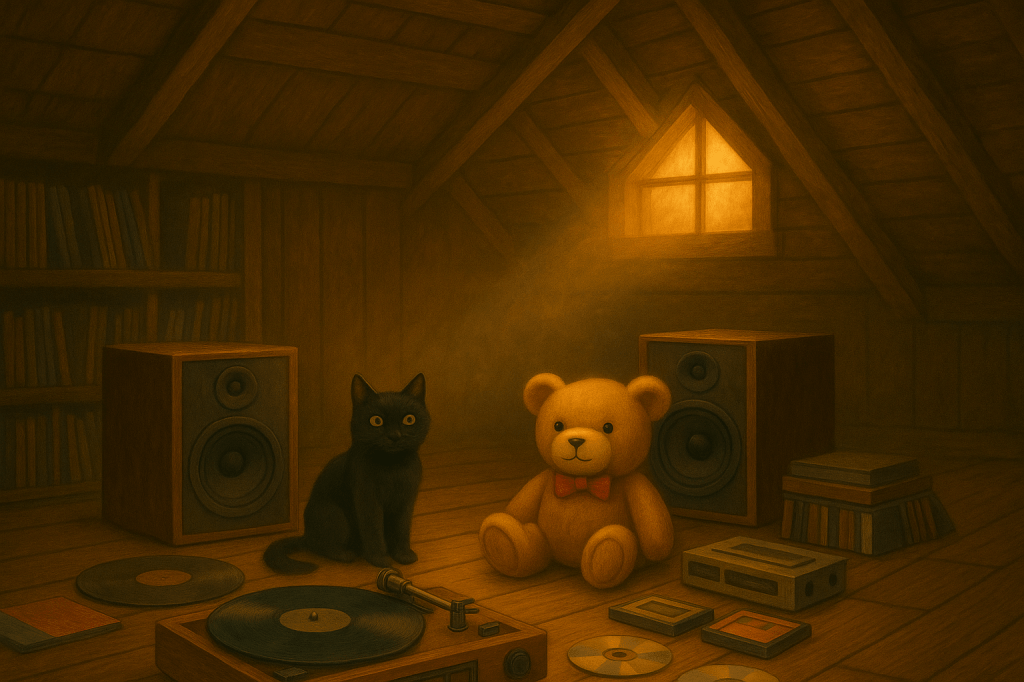
The Secret of the Music Bear in the Attic (ages 8+) is the one where Nero doesn’t take top billing — and proves the point anyway. Two brothers would never have found the talking teddy bear at all if a curious cat hadn’t led them up to the attic in the first place. What they find there is a bear who remembers every song, and a set of magical rooms built from musical memory: vinyl, cassettes, CDs, streaming, each one holding a story about how music used to live in our hands. Nero doesn’t sing, and he doesn’t explain. He just knows where the door is, which is a very old job for a cat — think of the Cheshire Cat pointing Alice down the path, or Puss simply deciding his master’s life was going to change today. Also available in Spanish as Tufi: El Osito Musical.
And for grown-ups, The Black Cat in the Back Row is our Sōseki book, if we’re allowed to be that presumptuous. It’s an illustrated novella about Antonio Vinoverde, an economics professor thirty years into a career he’s no longer sure mattered. A black cat appears in the back of his classroom, and what follows is gentle magical realism about attention, doubt, and the people who carry us farther than we’ll ever see.
That’s the thread running through all of it, and through every book on this list: the cat sees what we’ve stopped noticing, or knows the way to a room we’d never have opened. Sometimes it’s a joke. Sometimes it’s the whole story. And sometimes the cat isn’t the star at all — he just gets everyone to the attic and lets the bear do the talking.
Have a favorite cat book we left out? Tell us — we’re always taking recommendations, and so is Nero.